
States Hold Firm on Vaccine Policies Despite Federal Shift
Key Takeaways
- No state had changed its school vaccine policies to align with the Trump administration's August 10 executive order as of August 21, despite federal guidance that reduces recommended childhood vaccines and directs states to consider updating immunization requirements.
- Virginia, Maine, and New York reaffirmed their existing childhood vaccine requirements and continued following the American Academy of Pediatrics immunization schedule rather than adopting the new federal guidance.
- 30 states and D.C. have moved away from relying on CDC/ACIP recommendations for at least some childhood vaccines, with 27 states delinking for the full childhood schedule, reflecting a growing divide between state vaccine policies and federal guidance.
- The executive order calls for making certain vaccines like measles, mumps, and rubella available separately rather than only as combination products, though states with school immunization laws have not yet responded to this directive.
The Trump administration issued an executive order on August 10 establishing a new federal framework for childhood vaccines that reduces the number of vaccines routinely recommended for all children and directs states to consider updating laws and regulations governing immunization requirements, including those for school attendance. The order also calls for making certain vaccines, such as measles, mumps, and rubella, available separately rather than only as combination products. Despite the federal shift, no state had changed its school vaccine policies to align with the executive order as of August 21, according to KFF.
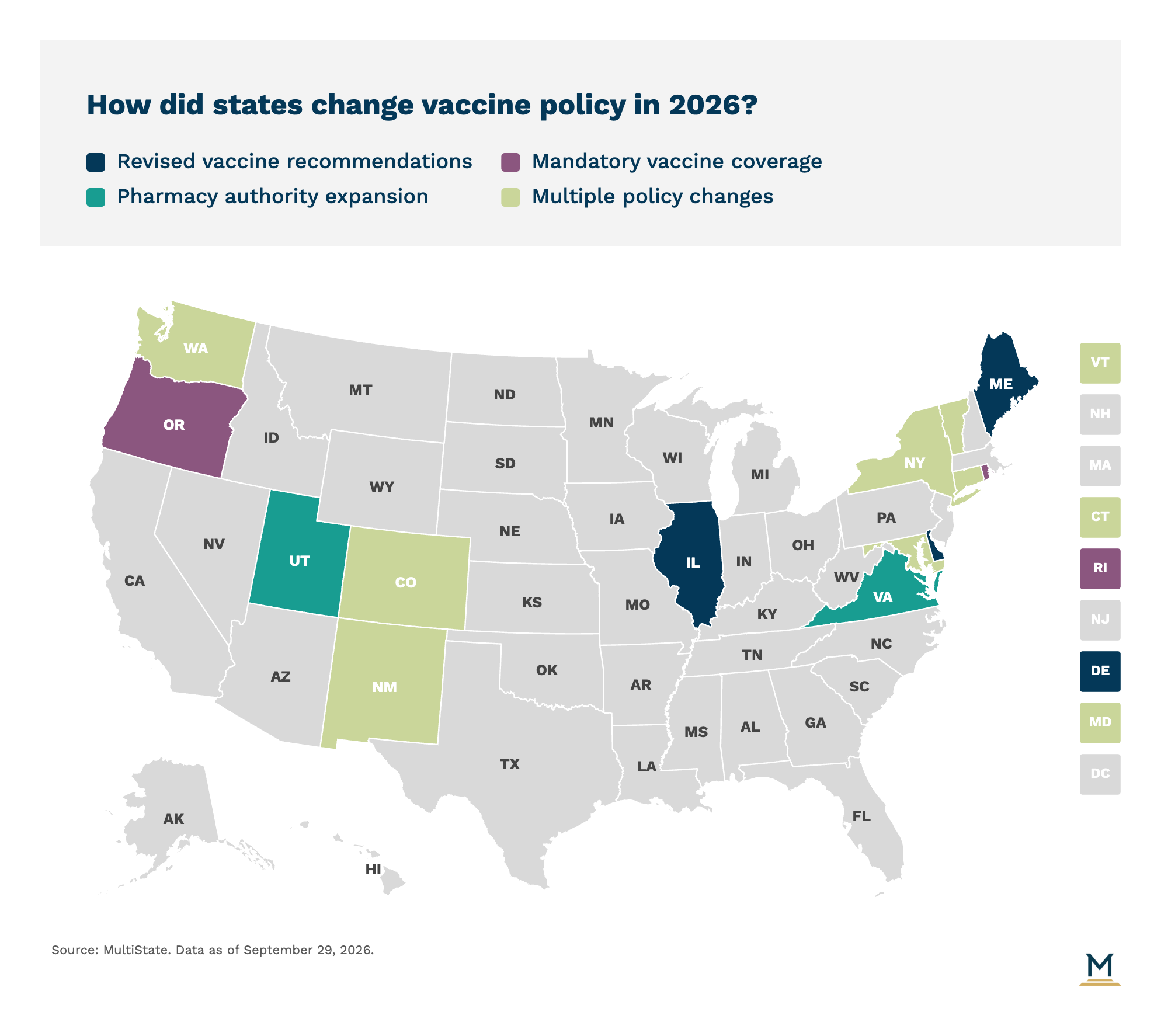
Several states instead reaffirmed their existing policies. Virginia said its school requirements would remain unchanged and that it would continue following the American Academy of Pediatrics (AAP) childhood immunization schedule. Maine similarly maintained its school and child-care requirements and continued its reliance on AAP guidance, while New York said the order would not alter its vaccine requirements or recommendations and reaffirmed its support for the combined MMR vaccine. More broadly, KFF reports that 30 states and D.C. have moved away from relying on CDC/ACIP recommendations for at least some childhood vaccines, including 27 that have delinked for the full childhood schedule, signaling a growing state-federal divide over vaccine policy.
Track Health Care Policy
The ever-evolving state health policy landscape will continue to influence how health care organizations make business decisions. MultiState's team pulls from decades of expertise to help you effectively navigate and engage. MultiState's team understands the issues, knows the key players and organizations, and we harness that expertise to help our clients effectively navigate and engage on their policy priorities. We offer customized strategic solutions to help you develop and execute a proactive multistate agenda focused on your company's goals. Learn more about our Health Care Policy Practice.
ACIP (Advisory Committee on Immunization Practices)
ACIP is a federal advisory committee that provides guidance to the CDC on vaccine recommendations for the U.S. population. The committee develops evidence-based recommendations for childhood, adolescent, and adult immunization schedules. Many states have historically incorporated ACIP recommendations into their school immunization requirements, though recent trends show states increasingly adopting alternative guidance sources.
Frequently Asked Questions
Are states required to change their school vaccine requirements based on the Trump administration's August 2025 executive order?
No, states are not required to change their school vaccine requirements based on the executive order. The order directs states to consider updating their immunization laws and regulations, but as of August 21, 2025, no state had modified its school vaccine policies in response. Several states, including Virginia, Maine, and New York, have explicitly reaffirmed their existing requirements.
Which states still follow CDC and ACIP recommendations for childhood vaccine schedules?
As of August 2025, 30 states and D.C. have moved away from relying on CDC/ACIP recommendations for at least some childhood vaccines, with 27 states delinking from the full childhood schedule. This reflects a significant state-federal divide in vaccine policy.
What childhood vaccine requirements did Virginia maintain after the federal executive order on vaccines?
Virginia maintained its existing school vaccine requirements unchanged and continues to follow the American Academy of Pediatrics (AAP) childhood immunization schedule. The state announced this position following the Trump administration's August 10, 2025 executive order that established a new federal framework reducing routinely recommended childhood vaccines.
Does the August 2025 federal executive order require MMR vaccines to be available separately?
The executive order calls for making certain vaccines, including measles, mumps, and rubella, available separately rather than only as combination products. However, states like New York have reaffirmed their support for the combined MMR vaccine and stated the order would not alter their vaccine requirements or recommendations.
What alternative guidance are states using instead of CDC recommendations for school immunization requirements?
Many states have shifted to following the American Academy of Pediatrics (AAP) childhood immunization schedule instead of CDC/ACIP recommendations. Virginia and Maine specifically cited their continued reliance on AAP guidance when reaffirming their school and child-care vaccine requirements in August 2025.