
Here's What Prescription Drug Affordability Boards Have Been Doing in 2025 (Upls, Affordability Reviews, and Expanded Authority)
Key Takeaways
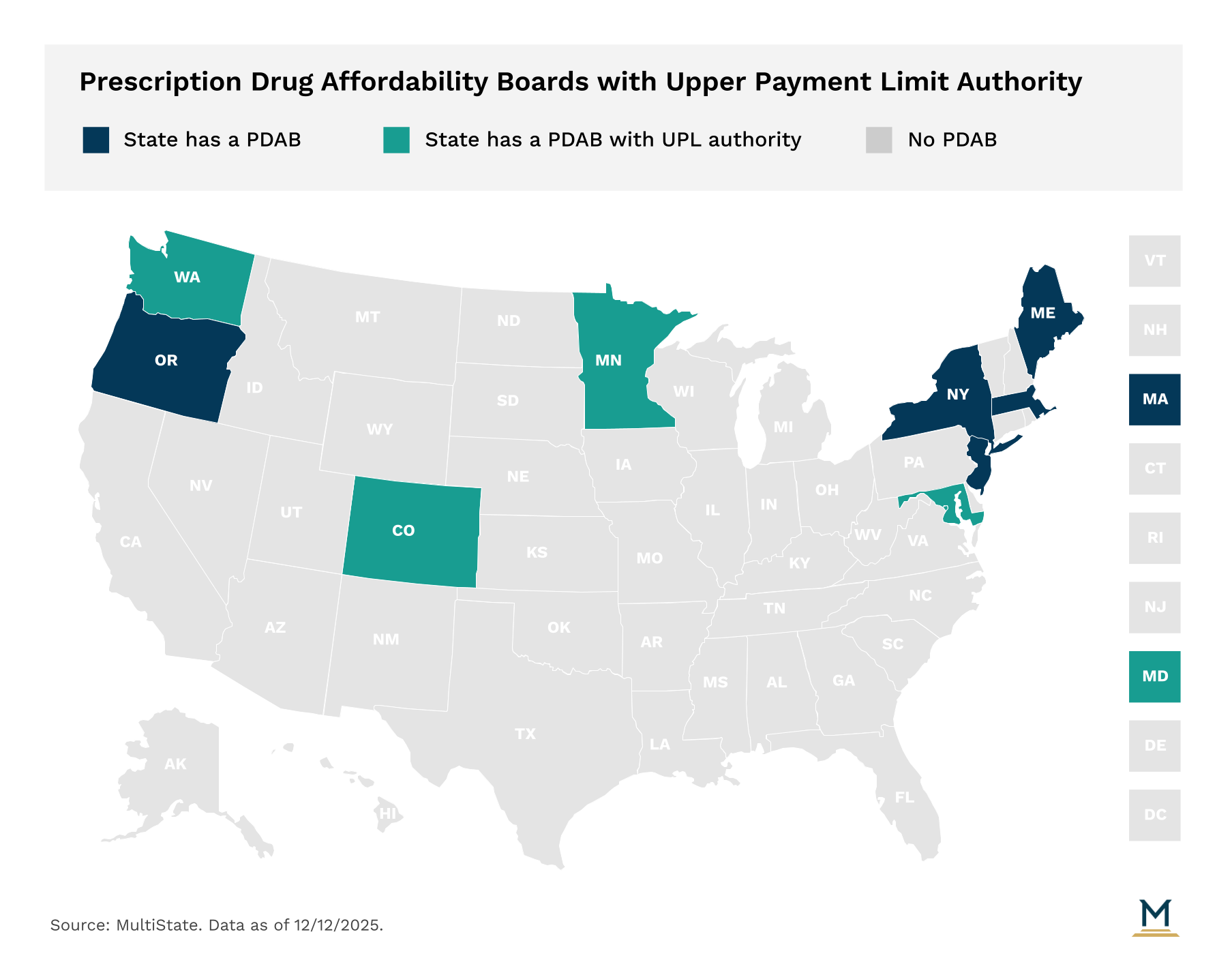
Prescription Drug Affordability Boards (PDABs) are gaining momentum across the US as states seek to control rising drug costs. Nine states now have these entities, with four having authority to set upper payment limits on unaffordable medications.
Colorado made history by setting the nation's first upper payment limit on Enbrel at $600 per dose, effective January 2027. The decision faced legal challenges from the manufacturer, with ongoing litigation potentially impacting PDAB viability nationwide.
Maryland identified four diabetes and weight-loss drugs as unaffordable and plans to set limits on Jardiance and Farxiga using Medicare pricing. Oregon reviewed 23 drugs and will release final affordability determinations in March 2026.
Washington and Minnesota are preparing for their first affordability reviews after spending 2025 building infrastructure and governance frameworks. Maine's governor will decide in January whether to expand their PDAB's authority to include cost reduction strategies.
Prescription Drug Affordability Boards (PDABs) are a key component of state drug pricing policy. Currently, nine states have PDABs or similar drug cost control entities. PDAB authority varies across states, and can include developing reports and policy recommendations, setting prescription drug spending benchmarks, conducting affordability or cost reviews on eligible drugs, or setting upper payment limits (UPLs). PDABs in four states (Colorado, Maryland, Minnesota, and Washington) have the authority to set UPLs on prescription drugs they determine to be unaffordable after review. There was notable legislative activity on PDABs in 2025, but the activity of the PDABs themselves is just as important to monitor, as PDABs progress in reviewing drugs, setting UPLs, and issuing policy recommendations.
Colorado Sets First-Ever Upper Payment Limit
In October, the Colorado PDAB finalized the nation’s first-ever upper payment limit (UPL) for a prescription drug. The UPL will cap the amount that purchasers and payers within the state can be required to pay for Enbrel, a biologic used to treat autoimmune diseases.
In February 2024, the PDAB conducted an affordability review of Enbrel, during which they determined the drug to be unaffordable for Colorado consumers and selected the drug for a UPL. Following four rulemaking hearings, the PDAB adopted a regulation to set Enbrel’s UPL at $600.00 per 50 mg/mL, which reflects the Medicare maximum fair price (MFP) rounded to the nearest hundred. The PDAB opted to utilize MFP as a benchmark for the UPL, contending that it is a negotiated price that leverages federal research and mechanisms, is significantly lower than other benchmarks, and could lead to savings for payers and consumers.
Throughout the rulemaking process, implementation and enforcement were key topics of discussion raised by stakeholders and the PDAB. In response, the PDAB set the UPL’s effective date for January 1, 2027, to allow time for insurers, PBMs, and pharmacies to make operational adjustments. As Colorado moves towards implementation, stakeholders and other states will be watching how the policy impacts access, affordability, and the broader supply chain.
Colorado’s PDAB has also been subject to litigation by the manufacturer of Enbrel over the UPL. The manufacturer originally filed a lawsuit in 2024 when the drug was first selected for a UPL, but the case was dismissed in March of this year. A district court determined that the manufacturer lacked standing since manufacturers are not subject to direct regulation under the law and, as an unregulated party, the injuries alleged were too speculative. After the UPL was set in October, the manufacturer filed another lawsuit arguing that UPLs interfere with federal patent laws, attempt to regulate economic activity outside of the state, and violate due process. The result of the ongoing litigation and interpretation of UPLs in court could have an impact on the viability of PDABs and UPLs nationwide.
State PDAB Affordability Review Activities Across the Nation
Maryland conducted cost review studies on four drugs this year. During the reviews, the PDAB made preliminary determinations that Jardiance, Farxiga, Ozempic, and Trulicity have created affordability challenges. The PDAB also went through the policy review process and identified UPL and non-UPL policies to address the affordability challenges for Jardiance and Farxiga. The PDAB expressed interest in non-UPL policy recommendations such as WAC inflation penalties, patient navigator programs, and PBM compensation reform. In November, the PDAB also reviewed UPL frameworks and voted to move forward with setting UPLs for Jardiance and Farxiga at MFP. The PDAB is now starting the policy review process for Ozempic and Trulicity, and is expected to review Dupixent and Skyrizi in early 2026.
The Oregon PDAB selected 23 drugs for affordability review this year. Throughout the year, the PDAB reviewed affordability packets for the drugs. The Governor and Legislature authorized the PDAB to extend the 2025 review process into 2026, and a final affordability report identifying at least 9 drugs as unaffordable and policy recommendations is expected in March 2026. The Oregon PDAB notably does not have UPL authority and opted not to include a recommendation for UPL authority in its 2025 annual report.
Emerging PDABs Build Infrastructure for Future Reviews
The PDABs in Washington and Minnesota are newer compared to the others, and have spent the past year preparing for affordability reviews. Washington selected Enbrel, Xtandi, Cabometyx, and Humira for affordability reviews in July. However, the PDAB has pushed the start of the reviews to at least March 2026, as they collect and analyze drug data.
Meanwhile, Minnesota focused on governance and organizational priorities in 2025, including hiring an executive director, developing mission, vision, and value statements, and adopting conflicts of interest and proprietary and trade secret information policies. There is potential for the PDAB to start affordability reviews in 2026, though they will need to establish a formal process and infrastructure for drug reviews, which may take time based on the experience of other states.
Maine Legislature Considers Expanded PDAB Authority
This year, the Maine legislature enrolled the legislation (LD 697) to expand the PDAB’s authority, but Governor Janet Mills (D) opted to postpone her decision on the bill until January 2026. If enacted, the bill would authorize the PDAB to assess strategies and make recommendations to reduce prescription drug costs, spending, and cost barriers, including an assessment of UPL authority, PBM regulation, and reference-based pricing. In recent meetings, the PDAB has discussed potential policy engagement strategies in anticipation of possible new authority.
Track Health Care Policy with StateVitals
StateVitals is the leading resource on how state governments are shaping healthcare policy and transforming care and delivery, brought to you by MultiState’s Health Care Policy Practice. MultiState’s policy and advocacy professionals are uniquely positioned to give you and your organization the big-picture view on state health policy reform, plus the latest trends on how policymakers are thinking about healthcare and similar emerging issues. Learn more about StateVitals, or schedule a demo here.