
Does Medicaid Cover IVF? State Coverage Laws in 2026
Key Takeaways
- No state Medicaid program covers IVF as a standard benefit. Only New York, Utah, and Washington, D.C. offer any Medicaid coverage for fertility treatment, and even those programs are narrowly limited.
- Utah is the only state with Medicaid IVF coverage, and it applies only to individuals with specific genetic conditions like cystic fibrosis or sickle cell anemia. Medicaid fertility preservation coverage is more common, with 7 states covering it for patients facing iatrogenic infertility from treatments like chemotherapy.
- On the private insurance side, state fertility coverage mandates have expanded considerably, with half of all states now requiring some level of fertility care coverage and 15 states specifically mandating IVF coverage.
- Fertility insurance coverage mandates vary widely in scope, covering different plan types, patient eligibility criteria, and services. Some states require broad access to assisted reproductive technology, while others limit coverage to specific diagnoses or cap the number of treatment cycles.
- For a broader look at how IVF and assisted reproductive technology laws have developed, fertility care and IVF access in 2025 offers useful context on the legislative trends shaping this space.
No state Medicaid program currently provides broad coverage for in vitro fertilization (IVF) as a standard benefit. However, Medicaid in some states may cover related fertility treatment, including ovulation-enhancing drugs and fertility preservation in limited circumstances. At the same time, fertility coverage in the private insurance market is changing, with a growing number of states enacting coverage mandates for some form of fertility care, and in certain states, IVF.
Understanding Fertility Insurance Mandates by Coverage Type
Fertility care coverage mandates vary across states, with some creating requirements for broad access to assisted reproductive technology, while others are much narrower in scope. Fertility insurance mandates vary in who and what they cover.
Which Health Plans Must Provide Fertility Coverage
In particular, coverage mandates generally apply to certain types of plans, such as state employee health plans, Medicaid programs, or commercial plans. State requirements generally do not apply to self-funded plans regulated under ERISA, certain small group plans, or religious employers.
Eligibility Requirements and Coverage Limitations
Mandates also vary in who is qualified for coverage, and sometimes include age, marital status, or diagnosis restrictions. Some state laws also establish coverage limitations, such as cycle or lifetime benefit caps or exclusions for donor services, surrogacy, or storage costs.
Types of Fertility Services Covered Under State Mandates
Finally, mandates range in what services plans must cover, and can include infertility diagnosis, fertility medications, embryo transfer, cryopreservation, fertility preservation, intrauterine insemination, and in vitro fertilization.
State Medicaid Fertility Treatment Coverage
Fertility treatment is not a mandatory Medicaid benefit under federal law, so states may choose to cover it. Most state Medicaid programs do not provide coverage for comprehensive fertility treatments.
States Offering Limited Medicaid Fertility Benefits
New York, Utah, and Washington, D.C are the only states that offer Medicaid coverage for infertility treatments, but even then, the coverage is limited. In New York and Washington, D.C., Medicaid coverage is restricted to three cycles of ovulation-inducing medications, and Utah implemented a state plan amendment in 2024 to provide Medicaid coverage for IVF and genetic testing, but only for carriers of certain genetic diseases.
Medicaid Coverage for Iatrogenic Infertility
The most common covered benefit under Medicaid programs is fertility preservation for those with iatrogenic infertility, which refers to infertility caused by medically necessary treatments, such as chemotherapy or other interventions that may impair reproductive ability, with 7 states requiring such coverage.
Which State Cover IVF and Fetility Care Under Medicaid?
| State | IVF Coverage | Fertility Preservation Coverage | Drug Coverage |
|---|---|---|---|
| Alabama | Not covered | Not covered | Not covered |
| Alaska | Not covered | Not covered | Not covered |
| Arizona | Not covered | Not covered | Not covered |
| Arkansas | Not covered | Not covered | Not covered |
| California | Not covered | Not covered | Not covered |
| Colorado | Not covered | Not covered | Not covered |
| Connecticut | Not covered | Not covered | Not covered |
| Delaware | Not covered | Not covered | Not covered |
| Florida | Not covered | Not covered | Not covered |
| Georgia | Not covered | Not covered | Not covered |
| Hawaii | Not covered | Not covered | Not covered |
| Idaho | Not covered | Not covered | Not covered |
| Illinois | Not covered | When a necessary medical treatment may directly or indirectly cause iatrogenic infertility. | Not covered |
| Indiana | Not covered | Not covered | Not covered |
| Iowa | Not covered | Not covered | Not covered |
| Kansas | Not covered | Not covered | Not covered |
| Kentucky | Not covered | Not covered | Not covered |
| Louisiana | Not covered | Not covered | Not covered |
| Maine | Not covered | Not covered | Not covered |
| Maryland | Not covered | When medical treatment may directly or indirectly cause iatrogenic infertility. | Not covered |
| Massachusetts | Not covered | Not covered | Not covered |
| Michigan | Not covered | Not covered | Not covered |
| Minnesota | Not covered | Not covered | Not covered |
| Mississippi | Not covered | Not covered | Not covered |
| Missouri | Not covered | Not covered | Not covered |
| Montana | Not covered | When diagnosed with cancer and the standard of care involves medical treatment that may directly or indirectly cause iatrogenic infertility. | Not covered |
| Nebraska | Not covered | Not covered | Not covered |
| Nevada | Not covered | When diagnosed with breast or ovarian cancer, and the cancer may directly or indirectly cause infertility, or the recipient is expected to receive medical treatment for the cancer, and such treatment may directly or indirectly cause infertility. | Not covered |
| New Hampshire | Not covered | Not covered | Not covered |
| New Jersey | Not covered | Not covered | Not covered |
| New Mexico | Not covered | Not covered | Not covered |
| New York | Not covered | When a medical treatment may directly or indirectly cause iatrogenic infertility, which is an impairment of fertility resulting from surgery, radiation, chemotherapy, sickle cell treatment, or other medical treatment affecting reproductive organs or processes | 3 cycles of ovulation-enhancing drugs |
| North Carolina | Not covered | Not covered | Not covered |
| North Dakota | Not covered | Not covered | Not covered |
| Ohio | Not covered | Not covered | Not covered |
| Oklahoma | Not covered | When diagnosed with cancer within reproductive age, medically necessary treatment may directly or indirectly cause iatrogenic infertility. | Not covered |
| Oregon | Not covered | Not covered | Not covered |
| Pennsylvania | Not covered | Not covered | Not covered |
| Rhode Island | Not covered | Not covered | Not covered |
| South Carolina | Not covered | Not covered | Not covered |
| South Dakota | Not covered | Not covered | Not covered |
| Tennessee | Not covered | Not covered | Not covered |
| Texas | Not covered | Not covered | Not covered |
| Utah | Targeted coverage for individuals who have one of the following conditions: Cystic fibrosis, spinal muscular atrophy, Morquio syndrome, myotonic dystrophy, or sickle cell anemia. | When diagnosed with a form of cancer that needs treatment that may cause a substantial risk of sterility or iatrogenic infertility. | Not covered |
| Vermont | Not covered | Not covered | Not covered |
| Virginia | Not covered | Not covered | Not covered |
| Washington | Not covered | Not covered | Not covered |
| Washington, D.C. | Not covered | Not covered | 3 cycles of ovulation-enhancing drugs and monitoring |
| West Virginia | Not covered | Not covered | Not covered |
| Wisconsin | Not covered | Not covered | Not covered |
| Wyoming | Not covered | Not covered | Not covered |
Private Insurance Fertility Coverage Mandates by State
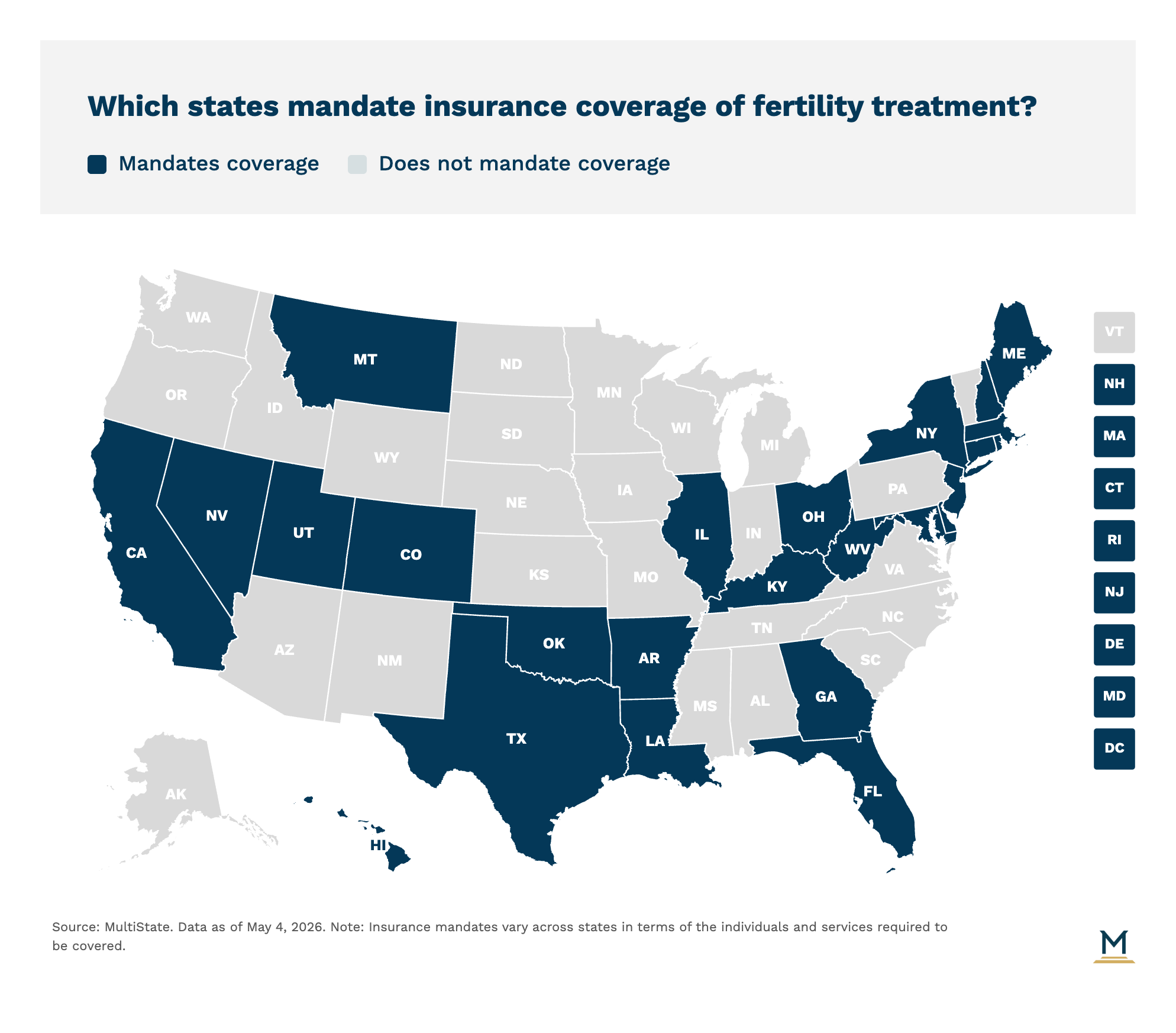
While states have been hesitant to expand Medicaid benefits to broadly cover IVF, state private insurance mandate laws have expanded, with half of the states requiring some level of coverage. Of note, 15 states now have IVF coverage mandates. Similar to Medicaid, fertility preservation for iatrogenic infertility caused by medically necessary treatments is the most popular coverage requirement, with 21 states requiring coverage.
Track Health Care Policy
The ever-evolving state health policy landscape will continue to influence how health care organizations make business decisions. MultiState's team pulls from decades of expertise to help you effectively navigate and engage. MultiState's team understands the issues, knows the key players and organizations, and we harness that expertise to help our clients effectively navigate and engage on their policy priorities. We offer customized strategic solutions to help you develop and execute a proactive multistate agenda focused on your company's goals. Learn more about our Health Care Policy Practice.