

New CMS Framework Helps States Determine Medicaid Frailty Exemptions from Work Requirements
CMS released a slide deck introducing an optional three-tiered framework to help states determine medical frailty exclusions from Medicaid community engagement requirements. The framework ranges from automatic qualification based on single ICD-10 codes for severe conditions to manual individualized reviews when data is insufficient. States including Georgia and Wisconsin can adopt, modify, or create alternative methodologies, provided they link conditions to functional impairment and remain auditable.

State Health Policy Action We're Watching in September 2026
September 2026 state health policy developments include Arkansas seeking a two-year extension for ARHOME covering 215,000 Medicaid expansion enrollees, Colorado successfully defending its 340B pharmacy protection law, Idaho's abortion ban ruled unconstitutional then narrowed on appeal, Indiana reprocuring Medicaid managed care for 1.5 million beneficiaries, and Texas courts staying mifepristone lawsuits while multiple states challenge nationwide abortion medication access.

States Rush to Meet Rural Health Transformation Program Reporting Requirements
The Rural Health Transformation Program allocates $10 billion annually through 2030, with CMS distributing funds to states based on rural population and facility needs. States awarded over 450 grants and must submit progress reports and Year 2 plans by August 31. By October 31, states must expend their full allocations ($147-$282 million each) or risk recoupment and reduced future funding.

States Begin Medicaid Work Requirements Implementation Ahead of 2027 Deadline
States are implementing Medicaid work requirements ahead of the January 1, 2027 federal deadline. Montana began implementation July 1, joining Nebraska, while Arkansas launched a soft rollout emphasizing education over terminations. Twenty-five states and DC sued CMS over the requirements, but a federal judge declined to pause implementation. States are now making critical administrative decisions on exemptions, data matching, and reporting processes.
CMS Medicaid Work Requirements Raise Coverage Loss Concerns
CMS released an interim final rule requiring Medicaid beneficiaries ages 19-64 to complete 80 hours monthly of work or qualifying activities starting January 1, 2027. While exemptions exist for pregnant individuals, caregivers, and medically frail beneficiaries, experts warn the narrower medical frailty definition could cause coverage losses. The rule is effective July 31, 2026, with public comments accepted through that date.
State Health Policy Action We’re Watching in July 2026
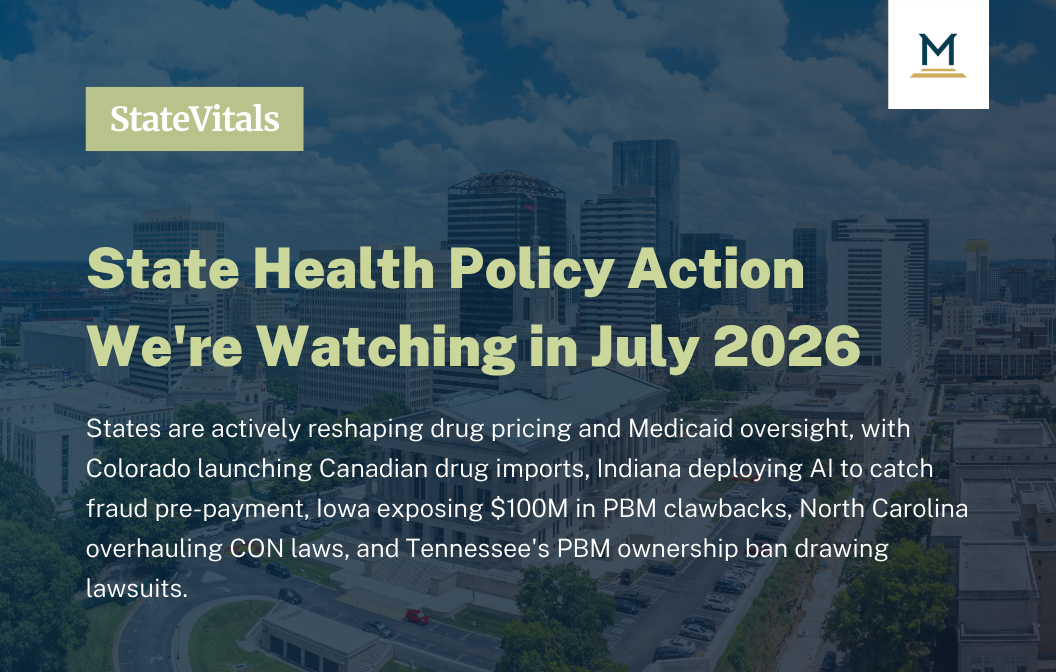
State health policymakers advanced drug cost and Medicaid reforms this month. Colorado received FDA authorization to import prescription drugs from Canada, projecting $46 million in savings over three years. Indiana partnered with CMS to deploy AI for pre-payment Medicaid fraud detection. Iowa auditors found PBMs collected $100 million through clawback arrangements from 2019-2021. North Carolina repealed certificate-of-need laws for rehabilitation facilities, while Tennessee's pharmacy-PBM separation law faces multiple constitutional challenges.

State Health Policy Action We’re Watching in June 2026
Five states enacted significant healthcare legislation during spring 2026 sessions. Arizona launched AI-powered Medicaid fraud detection, while Iowa banned insurers from using AI to deny prior authorizations under HF 2635. Missouri's comprehensive HB 2372 awaits gubernatorial approval, expanding Medicaid coverage and hospital transparency requirements. Maryland's Prescription Drug Affordability Board capped Ozempic payments at Medicare rates for state plans. Connecticut's budget bill (SB 1) overhauled Certificate of Need requirements for hospitals.

How State AGs Are Reshaping Federal Abortion Policy
The U.S. Supreme Court will decide by May 14, 2026, whether to reinstate mifepristone's in-person dispensing requirement nationwide, potentially reversing the FDA's 2023 change allowing telehealth prescriptions and mail distribution. Louisiana's lawsuit challenges this change, with courts finding the state likely has standing. Republican attorneys general from multiple states have filed cases targeting the FDA and out-of-state abortion medication providers, intensifying conflicts with Democratic states' shield laws.

Does Medicaid Cover GLP-1 Drugs? A State-by-State Guide (2026 Update)
Only 13 state Medicaid programs cover GLP-1 medications for weight loss as of early 2026, down from 17 states before January 1. California, New Hampshire, Pennsylvania, and South Carolina dropped coverage citing budgetary constraints. The 13 remaining states impose strict restrictions including BMI thresholds over 30, prior authorization, and step therapy requirements. CMS introduced the BALANCE demonstration program allowing states to expand coverage through negotiated pricing beginning May 2026.

Health Policy Rollup: State Action We’re Watching in February 2026
Florida's Senate Committee on Health Policy voted 6-4 on January 29th to advance SB 1756, the Medical Freedom Act, which prohibits the State Health Officer from ordering vaccinations and establishes conscience protections as exemptions from school-entry vaccine requirements. The bill requires providers to obtain signed informed consent before administering vaccines to minors and awaits consideration in the Appropriations Committee.
Health Policy Issues to Watch in 2026
As federal vaccine recommendations become less consistent, states are increasingly asserting independent authority over immunization policies. Several states formed regional collaboratives for vaccine guidance and procurement in late 2025, while others enacted legislation replacing federal recommendations with state-based advisories. Conversely, some states like Florida are moving to eliminate school vaccine mandates and emphasize parental choice through regulatory changes.

Health Policy Rollup: State Action We Watched in November 2025
Fifteen governors launched a public health alliance to improve emergency preparedness and coordination across state lines, while CMS announced all 50 states applied for the $50 billion Rural Health Transformation Program. California enacted major healthcare transparency and PBM oversight legislation, Colorado proposed significant Medicaid spending cuts, and Massachusetts advanced prior authorization reforms.