
State Prescription Drug Affordability Boards Face Legal and Strategic Crossroads
Key Takeaways
- A federal judge blocked Colorado's upper payment limit on Enbrel, ruling that state price controls on patented drugs likely violate federal patent law by undermining the market exclusivity Congress grants to incentivize innovation.
- State prescription drug affordability boards are facing a strategic crossroads as legal challenges question whether direct price-setting mechanisms can survive federal preemption arguments.
- Louisiana created the nation's newest affordability board through SB 401, but chose a transparency-focused model that requires drug pricing disclosures rather than implementing upper payment limits or affordability reviews.
- The Colorado ruling raises questions about whether prescription drug price controls remain viable for patented medications, though the impact on off-patent and generic drugs remains unclear.
- Jump to frequently asked questions ↓
Over the past few years, some states have turned to Prescription Drug Affordability Boards (PDABs) as a policy mechanism to address drug costs, but recent developments suggest that the policy approach is evolving.
How Has Colorado's Upper Payment Limit Policy Been Challenged?
The most significant development comes from Colorado, where a federal judge issued a preliminary injunction blocking the state's first-in-the-nation upper payment limit (UPL) on Amgen's arthritis drug, Enbrel.
What Led to the Federal Injunction Against Colorado's UPL?
The UPL, adopted by Colorado's PDAB in October 2025 and scheduled to take effect on January 1, 2027, capped reimbursement for the drug after the board determined it was unaffordable for Colorado consumers.
What Are the Legal Arguments and Implications of the Ruling?
In granting the injunction, the judge concluded that the UPL is likely preempted by federal patent law, reasoning that Congress intentionally provides patent holders with a period of market exclusivity and enhanced profits to incentivize innovation, and states may not upset that balance by imposing price controls on patented drugs. The court also rejected Colorado's argument that the UPL only affects downstream entities, finding that Amgen would likely suffer direct economic harm through lower payments and reduced negotiating leverage.
What Does the Ruling Mean for Future State Drug Pricing Policies?
While the ruling is only preliminary and litigation is expected to continue for months, it presents a significant challenge to the legal foundation of UPLs on patented drugs, and questions remain regarding the viability and value of UPLs for off-patent and generic products. The decision could influence whether states continue to pursue direct price-setting mechanisms or pivot towards alternative strategies.
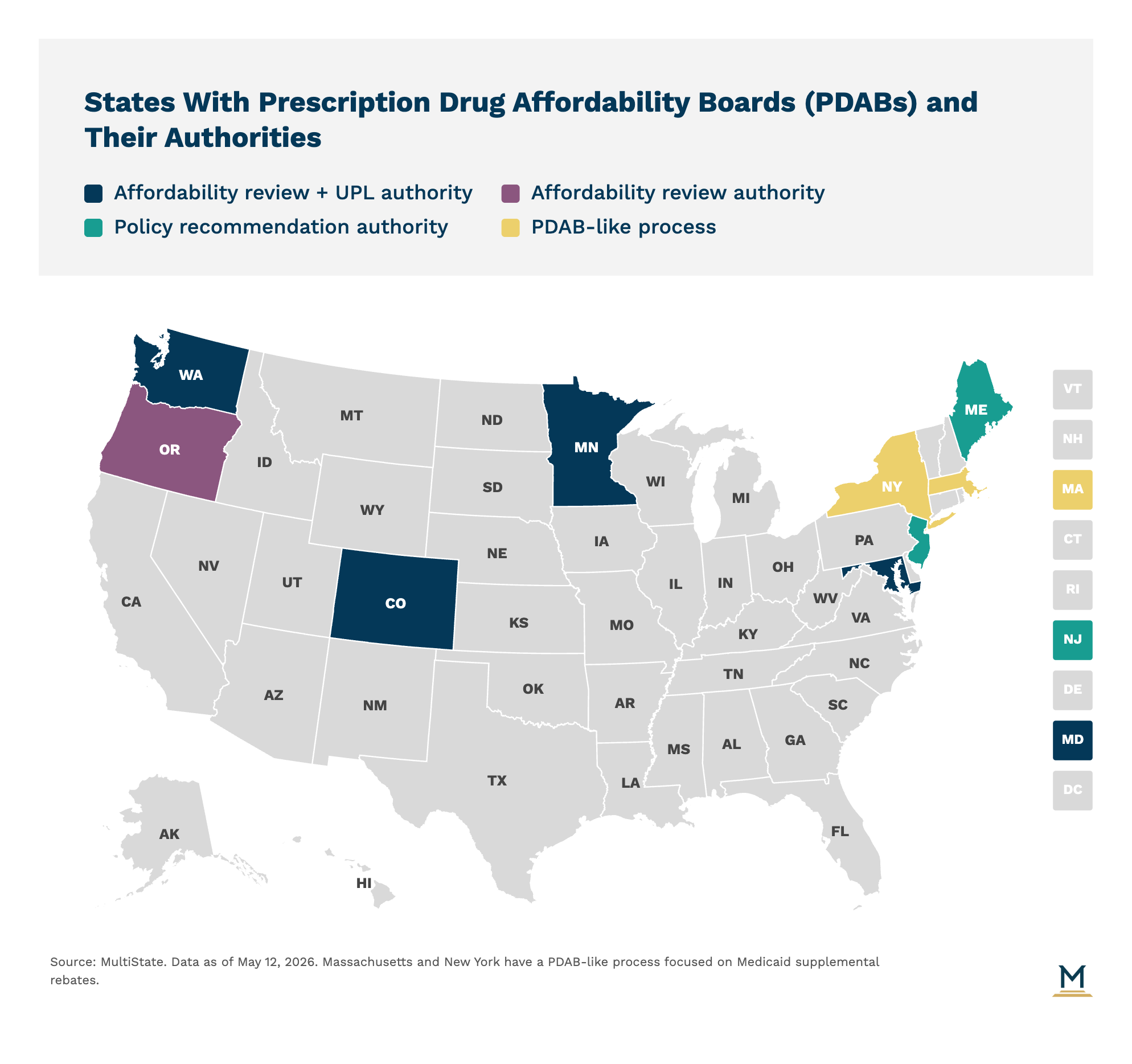
How Is Louisiana Approaching Prescription Drug Affordability?
At the same time, Louisiana has charted a different course. Governor Jeff Landry (R) recently signed legislation (SB 401) creating the nation's newest PDAB focused on transparency and reporting rather than affordability reviews and UPLs. The law requires manufacturers to provide information on wholesale acquisition cost increases, research and development expenditures, and pricing drivers for certain high-cost drugs. The model may offer states an alternative approach to addressing prescription drug affordability without engaging in direct price regulation.
Track Legal Activity and Other Policy Activity
Federal and state legal activity can have significant policy and regulatory implications for businesses and organizations. If your organization would like to further track federal and state legal activity, please contact us.
What did the federal court rule about Colorado's upper payment limit on Enbrel?
A federal judge issued a preliminary injunction blocking Colorado's upper payment limit on Enbrel, concluding that the limit is likely preempted by federal patent law. The court reasoned that states may not impose price controls on patented drugs because Congress intentionally provides patent holders with market exclusivity and enhanced profits to incentivize innovation. The ruling also found that Amgen would likely suffer direct economic harm through lower payments and reduced negotiating leverage.
How does Louisiana's prescription drug affordability board differ from Colorado's approach?
Louisiana's PDAB focuses on transparency and reporting rather than affordability reviews and upper payment limits. The board requires manufacturers to provide information on wholesale acquisition cost increases, research and development expenditures, and pricing drivers for certain high-cost drugs. This model represents an alternative approach to addressing prescription drug affordability without engaging in direct price regulation.
Can state prescription drug affordability boards set upper payment limits on generic drugs after the Colorado ruling?
The Colorado court decision specifically addressed upper payment limits on patented drugs, leaving questions about the viability and value of UPLs for off-patent and generic products. The preliminary injunction was based on federal patent law preemption, which would not apply to drugs no longer under patent protection. However, the practical effectiveness of price limits on generic drugs remains uncertain.
What information does Louisiana SB 401 require pharmaceutical manufacturers to report?
Louisiana SB 401 requires manufacturers to provide information on wholesale acquisition cost increases, research and development expenditures, and pricing drivers for certain high-cost drugs. The legislation creates a transparency-focused prescription drug affordability board rather than one with authority to set price limits. Governor Jeff Landry signed the legislation, establishing Louisiana's approach to prescription drug cost oversight.
Will the Colorado upper payment limit on Enbrel take effect in 2027?
No, the Colorado upper payment limit on Enbrel will not take effect as scheduled on January 1, 2027, due to the federal court's preliminary injunction. The UPL was adopted by Colorado's PDAB in October 2025, but litigation is expected to continue for months. The final outcome will depend on further court proceedings in the ongoing case.