
Colorado's Prescription Drug Affordability Board: What It Is and Why It Matters (Upper Payment Limits and Affordability Reviews)
Key Takeaways
- Colorado's Prescription Drug Affordability Board conducted affordability reviews on five drugs and determined that Enbrel, Stelara, and Cosentyx are unaffordable for consumers, while Trikafta and Genvoya were found affordable.
- In October 2025, Colorado became the first state to set a prescription drug upper payment limit, establishing a $600 cap per unit for Enbrel that takes effect January 1, 2027.
- The PDAB can review drugs with a wholesale acquisition cost of $3,000 or more, price increases of $300 or more in 12 months, or an average treatment cost of $30,000 per year.
- Colorado's PDAB faces ongoing litigation from manufacturers challenging whether upper payment limits interfere with federal patent laws and regulate commerce outside the state, which could affect how other states implement similar drug cost control measures.
- Jump to frequently asked questions ↓
Prescription Drug Affordability Boards in State Drug Pricing Policy
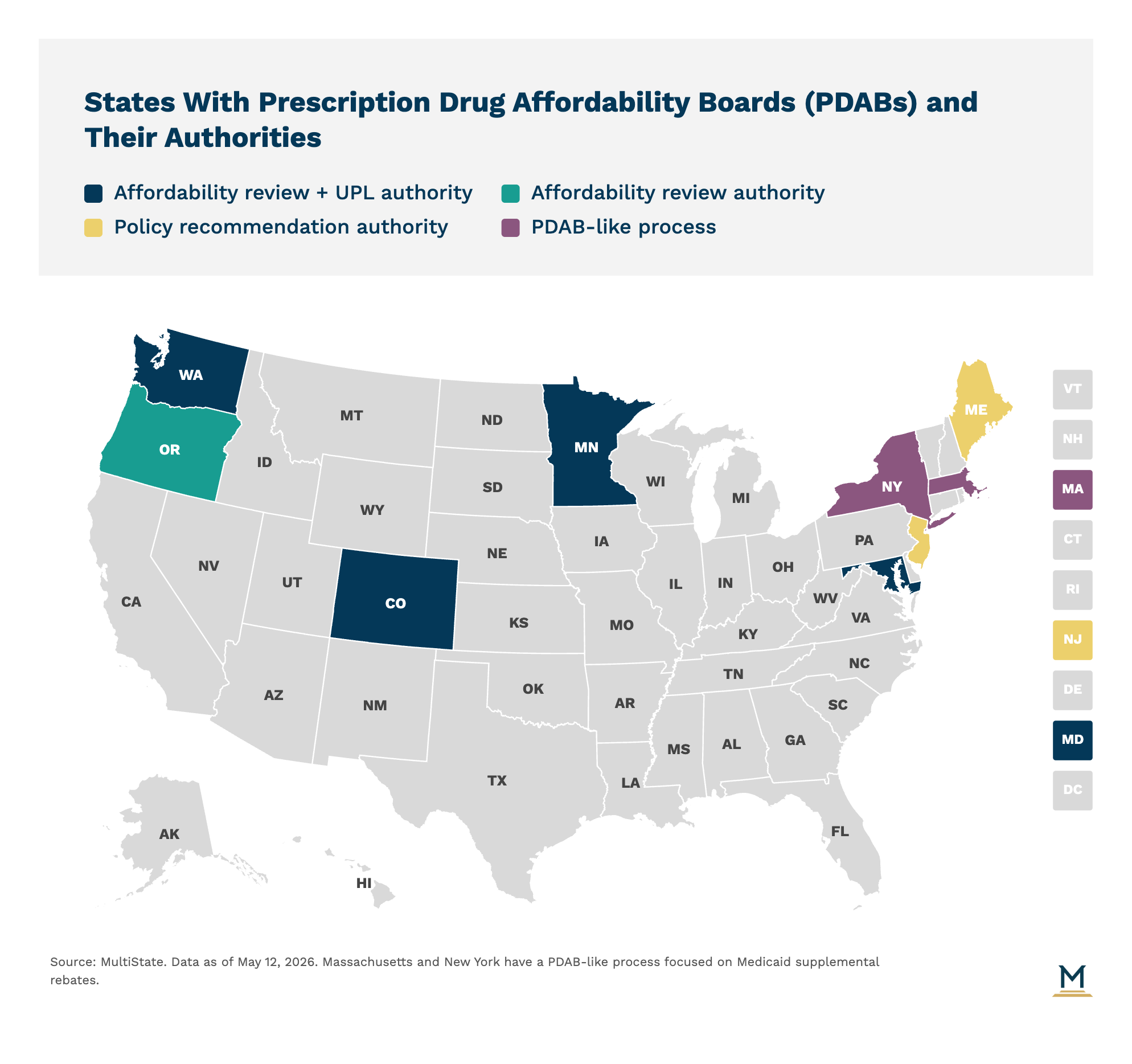
As states consider healthcare affordability issues, Prescription Drug Affordability Boards (PDABs) have emerged as a key debate in state drug pricing policy. Currently, nine states have active Prescription Drug Affordability Boards (PDABs) or similar drug cost control entities. PDAB authority varies across states, and can include developing reports and policy recommendations, setting prescription drug spending benchmarks, conducting affordability or cost reviews on eligible drugs, or setting upper payment limits (UPLs). PDABs in four states (Colorado, Maryland, Minnesota, and Washington) have the authority to set UPLs on prescription drugs they determine to be unaffordable after review.
What is the Colorado Prescription Drug Affordability Board?
The Colorado Prescription Drug Affordability Board (PDAB) was established in 2021 and is made up of five governor-appointed members with advanced degrees and experience or expertise in healthcare economics or clinical medicine. The PDAB is charged with protecting Colorado consumers from excessive prescription drug costs by collecting and evaluating information concerning the cost of prescription drugs sold to Colorado consumers, performing affordability reviews of prescription drugs, establishing upper payment limits for prescription drugs, and making policy recommendations to the General Assembly to improve prescription drug affordability.
What is an Affordability Review?
The PDAB may select eligible drugs for affordability review. Drug eligibility thresholds are set in statute, and currently, the PDAB has the authority to review any prescription drug with a wholesale acquisition cost (WAC) of $3,000 or more; an increase of $300 or more above the WAC for the prescription drug in the preceding 12 months; an increase of 200% or more above the WAC for the prescription drug in the preceding 12 months; or a current wholesale acquisition cost for an average course of treatment per person per year of thirty thousand dollars or more. Additionally they can review any biosimilar drug that has an initial WAC that is not at least 15% lower than the WAC of the corresponding biological product.
After identifying drugs that meet any of the criteria, the PDAB evaluates the eligible drugs and determines which drugs to conduct an affordability review on. During an affordability review, the PDAB reviews data and information on the drug, such as wholesale acquisition cost, cost of therapeutic alternatives, and patient cost sharing, as well as input from patients and providers, to determine whether use of the prescription drug is unaffordable for Colorado consumers.
What is an Upper Payment Limit?
The PDAB is authorized to set an upper payment limit (UPL) for any drug it has determined is unaffordable for Colorado consumers. An upper payment limit is the maximum amount that may be paid or billed for a prescription drug that is dispensed or distributed in Colorado. UPLs apply to all purchases of and payer reimbursements for a prescription drug that is dispensed or administered to individuals in the state in person, by mail, or by other means. The PDAB sets UPLs via the rulemaking process, and in doing so, must consider relevant costs, including the costs of administering, dispensing, or distributing the drug.
Wholesale Acquisition Cost (WAC)
The list price set by the drug manufacturer for sales to wholesalers or direct purchasers, not including rebates or discounts. WAC serves as a baseline price point before any negotiations or adjustments.
Biosimilar Drug
A biological product that is highly similar to and has no clinically meaningful differences from an existing FDA-approved biological product (called the reference product). Biosimilars are not generic drugs, as they are made from living organisms rather than chemical compounds.
Medicare Maximum Fair Price (MFP)
The negotiated price ceiling established through Medicare's drug price negotiation program under the Inflation Reduction Act. This represents the highest amount Medicare will pay for certain high-cost drugs after negotiation with manufacturers.
What Actions Has the Colorado PDAB Taken?
Affordability Reviews Conducted by the Colorado PDAB
In 2023, the Colorado PDAB selected 5 drugs for affordability review, and throughout 2023 and 2024, it conducted affordability reviews on the drugs. In the reviews, the PDAB determined that Enbrel, Stelara, and Cosentyx are unaffordable for Colorado consumers, while finding that Trikafta and Genvoya were not unaffordable.
Upper Payment Limits Set by the Colorado PDAB
Following review, the PDAB also selected Enbrel, Stelara, and Cosentyx for upper payment limits. In October 2025, Colorado set its first UPL for Enbrel after four rulemaking hearings. In setting the UPL, the PDAB utilized the Medicare maximum fair price (MFP) as a benchmark. The UPL was set at $600.00 per 50 milligram/milliliter unit, which is MFP rounded up to the nearest hundred, with an effective date of January 1, 2027, to give time for the PDAB to consider implementation considerations. UPLs for Stelara and Cosentyx have yet to be set, but the PDAB approved a notice of rulemaking for a UPL for Cosentyx in May 2026.
| Drug | Affordability Determination | Selected for UPL? | UPL Amount | UPL Effective Date |
|---|---|---|---|---|
| Trikafta | Not unaffordable | N/A | N/A | N/A |
| Genvoya | Not unaffordable | N/A | N/A | N/A |
| Enbrel | Unaffordable | Yes | $600.00 per 50 mg/mL unit (Maximum Fair Price rounded up) | January 1, 2027 |
| Stelara | Unaffordable | Yes | Pending | Pending |
| Cosentyx | Unaffordable | Yes | Pending - rulemaking scheduled to begin in June 2026 | Pending - rulemaking scheduled to begin in June 2026 |
Information as of May 26, 2026
Future Developments and Legal Challenges
Colorado is one of 9 states with a PDAB or similar entity to address rising drug costs. Notably, Colorado's PDAB is the furthest along in the process and was the first state to set a UPL. As the PDAB works through implementation and the UPL goes into effect, other states, particularly those with PDABs, will be watching to see the effect on the pharmaceutical supply chain and affordability for the state and patients.
In addition, the Colorado PDAB has also been subject to closely watched litigation. Following the PDAB's selection of Enbrel for a UPL in 2024, the drug's manufacturer filed a lawsuit against the PDAB, which was ultimately dismissed in March 2025, with a district court determining that the manufacturer lacked standing since manufacturers are not subject to direct regulation under the law and, as an unregulated party, the injuries alleged were too speculative.
After the UPL was set in October 2025, the manufacturer filed another lawsuit arguing that UPLs interfere with federal patent laws, attempt to regulate economic activity outside of the state, and violate due process. The litigation is still ongoing, and its result and interpretation of UPLs in court could have a significant impact on the implementation and viability of PDABs and UPLs going forward.
Track Health Care Policy
The ever-evolving state health policy landscape will continue to influence how health care organizations make business decisions. MultiState's team pulls from decades of expertise to help you effectively navigate and engage. MultiState's team understands the issues, knows the key players and organizations, and we harness that expertise to help our clients effectively navigate and engage on their policy priorities. We offer customized strategic solutions to help you develop and execute a proactive multistate agenda focused on your company's goals. Learn more about our Health Care Policy Practice.
What authority does the Colorado Prescription Drug Affordability Board have to control drug prices?
The Colorado PDAB can conduct affordability reviews of eligible prescription drugs and set upper payment limits (UPLs) on drugs it determines are unaffordable for Colorado consumers. UPLs establish the maximum amount that can be paid or billed for a prescription drug dispensed or distributed in Colorado, applying to all purchases and payer reimbursements. The Board also collects cost data, evaluates prescription drug pricing, and makes policy recommendations to the General Assembly.
Which drugs has the Colorado PDAB set upper payment limits on so far?
As of May 2026, Colorado has set one upper payment limit for Enbrel at $600.00 per 50 milligram/milliliter unit, effective January 1, 2027. The PDAB has selected two additional drugs—Stelara and Cosentyx—for UPLs after determining they are unaffordable, with rulemaking for Cosentyx scheduled to begin in June 2026. Stelara's UPL remains pending.
What makes a prescription drug eligible for affordability review by the Colorado PDAB?
A drug is eligible if it has a wholesale acquisition cost of $3,000 or more, an increase of $300 or more in the preceding 12 months, an increase of 200% or more in the preceding 12 months, or a WAC of $30,000 or more for an average course of treatment per year. Biosimilar drugs with an initial WAC that is not at least 15% lower than the corresponding biological product are also eligible. The PDAB then evaluates eligible drugs to determine which ones to review.
What legal challenges has the Colorado PDAB faced over upper payment limits?
Following the selection and setting of a UPL for Enbrel, the drug's manufacturer filed two lawsuits against the PDAB. The first lawsuit was dismissed in March 2025 when a district court determined the manufacturer lacked standing because manufacturers are not directly regulated under the law. The second lawsuit, filed after the UPL was set in October 2025, argues that UPLs interfere with federal patent laws, attempt to regulate economic activity outside Colorado, and violate due process; this litigation remains ongoing.
How many states have prescription drug affordability boards with authority to set upper payment limits?
Four states (Colorado, Maryland, Minnesota, and Washington) have PDABs with authority to set upper payment limits on prescription drugs they determine to be unaffordable. Nine states total have active PDABs or similar drug cost control entities, though PDAB authority varies across states and can include developing reports, setting spending benchmarks, or conducting affordability reviews without UPL authority.